Saturday, November 27, 2010
Monday, November 22, 2010
Darkness and Promise
THE REASON I, and no doubt legions of other no-longer-boys staring down hairloss and paunchiness, am so excited about this ridiculous new Springsteen box thing is that it chronicles the Turning Point in the man's classic oeuvre.Simply: there is a transition in every man's life from Born to Run to Darkness on the Edge of Town, a time when, suddenly, the rah-rah defiance of Born gives way to the crushing weight of Real Life. “No Surrender” and “Thunder Road” and “Born to Run” still mean something, they still rouse the spirit every time they're played, but it becomes a matter of nostalgia, whereas Darkness etches a place that has become much more familiar to him, a compromised existence -- “trouble in the heartland” -- that wasn't exactly what he had in mind when he was still young and girlcrazy and half certain he ejaculated rocket fuel. But there he is.
Make no mistake, he's still aflame with a desire to go out at night and find out what he's got, maybe more than ever before, but he's a little worried about what he might find. The confidence and certainty are gone. All he knows for sure are the love and faith that make getting up in the morning possible.
SONY IS PROBABLY the best of the majors when it comes to putting together these sorts of massive packages – maybe from all their experience cashing in on Miles' legacy – so I have no doubt that the box is worth delving into. But what seems more intriguing to me (and less likely to result in darkness in the middle of my wallet) is The Promise, the stand-alone double-album worth of material that didn't make the cut for inclusion on Darkness way back in 1978. This is the stuff, universally lauded as album-worthy, that Springsteen trimmed away to reveal the darkness of Darkness. This is the stuff deemed extraneous. You get the sense that there's plenty to be gleaned from these tailings, a sort of shadow version of the man's/America's mentality circa '77-'78.
SPRINGSTEEN IS A tough sell among a certain demo, mostly because the boomers think they own him. That makes it hard for some to think of him as possessing currency. But the fact is they own him like I own him, which is to say not at all. But it can be tempting, can't it, to look at the details of what an artist has produced, to feel a kinship, a recognition, and to declare yours the only generation who'll truly get it. “You had to be there.” Bullshit. Show me a time, a place, populated by people who didn't, at one time or another, seeth with the urge “to spit in the face of these badlands.”
But at work there's a crappy version of “Merry Christmas, Baby” in rotation, calling to my coworkers' minds the vision of a hunch-shouldered and pandering Bruce, grinning and beaming, dancing with Courtney Cox, hamming it up with Clarence. So when I express admiration in the face of such evidence of lameness, eyes roll. That's fine. I start up conversations with the older guys coming in to lay down their $100 for the thing, they smile and shake their heads and then they take it home and watch the DVDs alone, listen to the CDs alone, wives elsewhere, uninterested, kids scoffing. If I had the spare money, I'd do the same.
PICK A CLICHE and it fits me like a pair of size 11 Blundstones. The “writer” working retail. The father of three rushing headlong toward a midlife something. The jazz fan who thinks “if people would only give it a chance...” The white guy in plaid shirts who thinks Bruuuuce! a kind of demigod. But all I know is this: there are works of art, cultural artifacts, that seem to warp the very air around them, that hum and glow, overshadowing lesser works, speaking to something vital or unassailable. These things make so many of your other things seem worthless, trivial, unworthy of the space they occupy. Springsteen is, it seems to me, the author of several such works, including Darkness on the Edge of Town, and I welcome the chance to spy on the process of creating such a work that these two (undeniably cash-grabby) releases offer me. Call me curious. Call me a sucker. Call me old. I don't mind a bit.
Monday, November 15, 2010
The Antidote
BECAUSE YOU FIND yourself singing along to Rihanna and Taio Cruz while at work, just because they're on, sweet heaven they are always on, you find yourself during your home hours reaching for an antidote of sorts to make sure you're not still singing Want you to make me feel like I'm the only girl in the world as you drift off toward a fitful and brief sleep. The antidote takes many shapes, but of late it has looked and tasted like: Exploding Star Orchestra, Stars Have Shapes
...and the 900 or so songs on the ipod that you've rated at 5 stars, in a seemingly never-ending shuffle, like hit radio as programmed by you, which has put you at one side of a kind of soft war with your wife, who skips a song or changes the program every time you leave the room. Too much Neutral Milk Hotel? Probably. But you can never OD on RFTC or The Clash, is how you see it.
Sunday, October 24, 2010
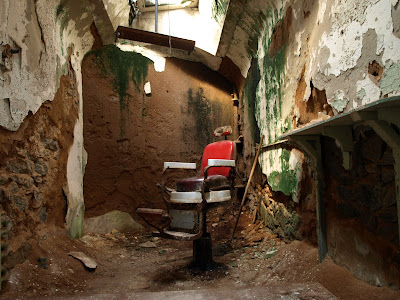
Among the Ruins
Eastern State Penitentiary, Philadelphia
(operated 1829-1971)
Photo by AGF
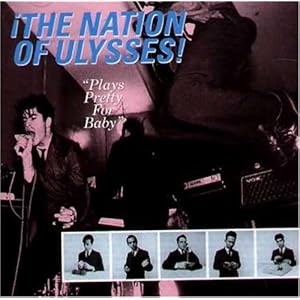
I'VE BEEN sussing the connections between urban exploration and unitary urbanism, my efforts set to the squeal and clank of the Nation of Ulysses' brilliant neo-Situationist missive Plays Pretty for Baby. In some imaginary, pre-responsibility* youth, I see myself scaling rusted ladders in enormous subterranean tunnels to the ear-gutting cacophony of “The Kingdom of Heaven Must Be Taken by Storm” as played on cheap speakers duct-taped to my belt.
AFTER ALL, what is UE if not an attempt to reclaim that which most of us never consented to relinquish? An assault on the notion of perpetual ownership? A mobilized form of squatting? A waking dream aimed at re-imagining, redrawing, redressing the levels and vistas available to us as (ex-/sub-) urban dwellers?
OLD IDEAS become compost in the new city. Christopher Payne's book (and Oliver Sachs' introduction of same) forced me to reconsider the idea of asylum – less Arkham, more sanctuary, safe bosom, respite – the idea nevertheless lost, or mistranslated across scant few generations, as the human cost vs. hard currency pendulum swung wide in the other direction, lopping off heads as it traversed its course. Now all we have are hulls, husks, mute ghosts, and beautiful photographs.
Once social institutions crumble, we simply leave the buildings that housed them to do the same. We just walk away. Or how about this: we institutionalize civic compassion only when a certain set of economic conditions are present, and when these conditions cease to be, we can no longer afford said values. So, is civic compassion a luxury? Which is to say: once the Baby Boomers are through ravaging health care and pensions, will we have to forsake those values? And will the buildings that now house these apparatuses then fall into ruin?
THE UPSIDE: burgeoning armies of young rats abandoning Krylon for Cannon, Olympus or Nikon. Their directive is shifting from redecorating to preserving, cataloguing, archiving. The thrill must be similar. There are still dark passages, security guards, and razor wire to shimmy beneath, around and over. In Japan they call it haikyo. Why do the Japanese always have terms for these things before we do?
In Peterborough the methadone clinic is in a building erected in 1848, the last all-stone edifice put up here. There's a pizza joint next door. Just down the street, in another aged building, an old-school hardware store, the kind with uneven floors and cramped aisles. I love these buildings. I'd rather see them used than explored, they're better standing than razed to make room for whatever. That's part of this town's appeal: most of it is still standing, including the alluringly fenced-off GE campus, with some buildings dating back 100 years, to when the damn thing was opened by Edison himself! Electric City, indeed! Imagine the shit that lies rusting, bricked off, forgotten, piled-upon in there. It sits there like a giant black box, a question mark. From the road, through the fence, you only get glimpses. There are railroad tracks that disappear into the solid sides of buildings.
GE's still a going concern, miraculously, that campus still active, but virtually everywhere you look there exists abandonment, past endeavour sliding to ruin. What's alluring about these places, forgotten by most, might be the inherent metaphor of imminent collapse. That's the sound of the Nation of Ulysses' music, too; what structure is present threatens to come crashing down at any moment. This is no twee screed, but a battle cry consisting of skronk, thrash, Stooge-like noise, and arty aural pastiche. There is pressure from within and without. In time, we know, there will be only strata of linoleum, paint, wallboard and rot in the case of the soon-to-fall buildings – or scattered cultural-archeological findings to be re-purposed as an aesthetic, in NOU's case: suits, hair, sound, dogma. Dig it up, pry back the plywood, dust it off and remember what others have forgotten.
(For the time being, let's refrain from considering the seismic shift, Bush to Bush, that has meant that a gaggle of poseur agitators who were, in their time, inspirational but to be consumed with a knowing wink, would now, thanks to their penchant for titles like 13 Point Plan to Destroy America, be added to watch lists, or some other such shit. Let's just hold off thinking about how unbelievably stupid that is, alright, and about what it says about how shitty our lives have become, and about all that we have lost, in many cases willingly so, and what we are leaving to our kids. Okay?)
This is all front-of-mind for me these days, I think, because of where I have returned to work, i.e. the cruel and ever-shrivelling teat of music/video retail. When in the mall I am struck by the duelling desires to revel in so much commercial excess (dance to the end of the world!) and to see it all collapse tidily into its own footprint. I want to know what the place will look like once barren and empty. What will we leave behind? What ravages will nature visit upon the place? Maple trees in the food court?
OR, FORGET the Nation of Ulysses, put them out of mind, flourish and exeunt, fire them from their post as the house band at the post-historic dinner club. You know that exercise where they play stock footage of a bear, or a lion, or some other such menacing beast, and the soundtrack is ominous, dreadful, plodding, but then they play the same clip set to, I don't know, Henry Mancini or something, and you go, “Oh man, my filmic impressions are almost completely driven by the score! I'm such a pawn!” Well, reconsider... maybe in place of the Nation of Ulysses, we play something by Jason Adasiewicz, and what we see are dust motes merrily dancing through a lovely shaft of light. Adasiewicz' vibraphone is crystalline, pure – the mood is jaunty, offhandedly fun. We are cheered by the notion that dogged beauty exists in the places where our ruin is most glaringly obvious.
* The responsibility of parenthood is no construct, of course, no arbitrary enslavement in the unfeeling gears of the capitalist, imperialist mindfuck, but rather a very real, human impulse – a need – and one which no amount of debasement, humiliation, drudgery nor wage imprisonment can nullify. Feed them! Care for them! March off toward the front in the vain hope that they will not one day have to do the same for their children. Report back to me at a later date: is there anything so fulfilling?
OLD IDEAS become compost in the new city. Christopher Payne's book (and Oliver Sachs' introduction of same) forced me to reconsider the idea of asylum – less Arkham, more sanctuary, safe bosom, respite – the idea nevertheless lost, or mistranslated across scant few generations, as the human cost vs. hard currency pendulum swung wide in the other direction, lopping off heads as it traversed its course. Now all we have are hulls, husks, mute ghosts, and beautiful photographs.
Once social institutions crumble, we simply leave the buildings that housed them to do the same. We just walk away. Or how about this: we institutionalize civic compassion only when a certain set of economic conditions are present, and when these conditions cease to be, we can no longer afford said values. So, is civic compassion a luxury? Which is to say: once the Baby Boomers are through ravaging health care and pensions, will we have to forsake those values? And will the buildings that now house these apparatuses then fall into ruin?
THE UPSIDE: burgeoning armies of young rats abandoning Krylon for Cannon, Olympus or Nikon. Their directive is shifting from redecorating to preserving, cataloguing, archiving. The thrill must be similar. There are still dark passages, security guards, and razor wire to shimmy beneath, around and over. In Japan they call it haikyo. Why do the Japanese always have terms for these things before we do?
In Peterborough the methadone clinic is in a building erected in 1848, the last all-stone edifice put up here. There's a pizza joint next door. Just down the street, in another aged building, an old-school hardware store, the kind with uneven floors and cramped aisles. I love these buildings. I'd rather see them used than explored, they're better standing than razed to make room for whatever. That's part of this town's appeal: most of it is still standing, including the alluringly fenced-off GE campus, with some buildings dating back 100 years, to when the damn thing was opened by Edison himself! Electric City, indeed! Imagine the shit that lies rusting, bricked off, forgotten, piled-upon in there. It sits there like a giant black box, a question mark. From the road, through the fence, you only get glimpses. There are railroad tracks that disappear into the solid sides of buildings.
GE's still a going concern, miraculously, that campus still active, but virtually everywhere you look there exists abandonment, past endeavour sliding to ruin. What's alluring about these places, forgotten by most, might be the inherent metaphor of imminent collapse. That's the sound of the Nation of Ulysses' music, too; what structure is present threatens to come crashing down at any moment. This is no twee screed, but a battle cry consisting of skronk, thrash, Stooge-like noise, and arty aural pastiche. There is pressure from within and without. In time, we know, there will be only strata of linoleum, paint, wallboard and rot in the case of the soon-to-fall buildings – or scattered cultural-archeological findings to be re-purposed as an aesthetic, in NOU's case: suits, hair, sound, dogma. Dig it up, pry back the plywood, dust it off and remember what others have forgotten.
(For the time being, let's refrain from considering the seismic shift, Bush to Bush, that has meant that a gaggle of poseur agitators who were, in their time, inspirational but to be consumed with a knowing wink, would now, thanks to their penchant for titles like 13 Point Plan to Destroy America, be added to watch lists, or some other such shit. Let's just hold off thinking about how unbelievably stupid that is, alright, and about what it says about how shitty our lives have become, and about all that we have lost, in many cases willingly so, and what we are leaving to our kids. Okay?)
This is all front-of-mind for me these days, I think, because of where I have returned to work, i.e. the cruel and ever-shrivelling teat of music/video retail. When in the mall I am struck by the duelling desires to revel in so much commercial excess (dance to the end of the world!) and to see it all collapse tidily into its own footprint. I want to know what the place will look like once barren and empty. What will we leave behind? What ravages will nature visit upon the place? Maple trees in the food court?
OR, FORGET the Nation of Ulysses, put them out of mind, flourish and exeunt, fire them from their post as the house band at the post-historic dinner club. You know that exercise where they play stock footage of a bear, or a lion, or some other such menacing beast, and the soundtrack is ominous, dreadful, plodding, but then they play the same clip set to, I don't know, Henry Mancini or something, and you go, “Oh man, my filmic impressions are almost completely driven by the score! I'm such a pawn!” Well, reconsider... maybe in place of the Nation of Ulysses, we play something by Jason Adasiewicz, and what we see are dust motes merrily dancing through a lovely shaft of light. Adasiewicz' vibraphone is crystalline, pure – the mood is jaunty, offhandedly fun. We are cheered by the notion that dogged beauty exists in the places where our ruin is most glaringly obvious.
* The responsibility of parenthood is no construct, of course, no arbitrary enslavement in the unfeeling gears of the capitalist, imperialist mindfuck, but rather a very real, human impulse – a need – and one which no amount of debasement, humiliation, drudgery nor wage imprisonment can nullify. Feed them! Care for them! March off toward the front in the vain hope that they will not one day have to do the same for their children. Report back to me at a later date: is there anything so fulfilling?
Thursday, October 21, 2010
Sweet Earth Flying
Tuesday, October 19, 2010
1989
In 1989 I was 13 years old and just becoming politicized. I wasn't a militant young black man, but what I gleaned from PE was that there were things worth changing, and the possibility existed that we just might change them. We were going to create racial equality, harmony, understanding, tolerance. We were going to cure AIDS, eliminate hunger, colonize space, save the damn planet. The fuck happened?
Musically, holy shit -- pick a style, let me point to a seminal (or at least important, or at the very least "pretty damn good") album released that year. How about Full Moon Fever, 3 Feet High and Rising, Doolittle, Raw Like Sushi, The Stone Roses, Bleach, The Real Thing, Margin Walker and Paul's Boutique?
I don't want to fawn over what then held cache and now looks hopelessly kitschy ("the hair was funny! the pants were big!"), but try to remember what it felt like to be alive then (if applicable). It was naive and fresh and fun. We were smack in the middle of the Golden Age of Rap. Nobody had died since John Lennon. Am I remembering this right? The goddamned Berlin Wall fell! Communism was totally on its last legs. And even if the notion that The People made it happen turned out to be a romantic exaggeration (cf: Bulgarian blue jeans, heavy debt loads, inept leadership, wasteful and redundant systems... any of this sound startlingly familiar?), it sure felt like the future was a ripe oyster eager to split itself open and reveal to us, the youth, its slick and shiny treasure.
Ha ha!
Thursday, October 7, 2010
In Rotation: The Cole Porter Song Book
Subscribe to:
Posts (Atom)