Wednesday, August 12, 2009
Hear This
Tuesday, July 7, 2009
Don't Give Up On Us
I GUESS I EXPECTED, if indeed I ever really thought about it, that songs like “I’m in Trouble” and “Bastards of Young” and “Here Comes a Regular” and “Can’t Hardly Wait” and would mean less to me by the time I hit my early-mid-thirties. I anticipated outgrowing the mix of crushing doubt, intense desire and unsubtle antipathy which supply the lifeblood of the Replacements’ music by the time I was married, had a child and a mortgage in a place geographically (if not spiritually) removed from the sodium-lit streets of my upbringing. So why do I need those songs now more than ever? Is it a simple, and paralyzingly depressing case of an early-midlife crisis?
Look, I’m ripe for depression these days. There’s no sense denying that. We moved to a new town last year and the truth is I haven’t taken to it so well just yet. It was a big change, and we were primed for it, sincerely hopeful. I also kind of felt like I had pretty well scotched things in Ottawa, why not try someplace new? And Peterborough is a good place, a nice town. But I haven’t really settled in yet, haven’t met anybody, haven’t joined anything. I stay at home with our daughter, take her to the library, the YMCA, talk to other parents, almost exclusively mothers. We live in an enlightened age, I know, and Peterborough’s a thoroughly liberal town, but a stay-at-home father’s still an anomaly. There are emotional barriers to forging friendships with those mothers. To boot, the move has exposed to great relief those guarded aspects of my personality; I don’t make friends easily (it doesn’t help that I never know what to say). So here I am, spending most of my days speaking only to my wife and our toddler. Night falls and I consider heading downstairs to my basement office to do some writing, but damn it, I’m tired, so a beer and a ballgame on TV is just about my speed. Then wham, it’s 11:00, I’m braindead exhausted, and I hate myself for wasting another evening.
Those are my days.
I’m isolated, treading water. And yeah, that’s got me down. So anything with the rosy tinge of the past, the faint whiff of a time when I felt more hope, is bound to appeal to me right now, and I get that. But with the Replacements, it feels like it’s more than that. It has something to do with the feeling that you’re running out of time.
MY WIFE is good to me. She basically understands what I’m feeling these days. She knows that while she’s landed in a new job and worked her way into a social circle, for me there isn’t the same joy concerning our new situation as there is for her. So when I say, “I need to head out to a movie tonight,” she’s fine with that. And when I said, “I think I need to get away for a weekend, by myself,” she was fine with that, too. She didn’t have to say, “Watch your budget,” because I understood that. It wasn’t as though I thought it would be prudent to fly to New York City for the weekend. But a short, economical road trip around Lake Ontario? Yeah, she was alright with that.
So Google Maps and I devised an itinerary: I would hit Buffalo, rattle around, have a bite and then take in a ballgame on Friday, all before the big prize, Rochester.
When I was a kid all our American network TV came from Rochester. I was raised on Rochester TV, so it’s maintained an undeserved air of nostalgia and mystery. I knew neighbourhoods, street names, business and personalities. I had this sense that, even without ever having gone there, I could find my way around the city; might actually feel a little bit at home there. Drive the streets, see the sights, go to a ballgame, and then cap it all with a visit to the great House of Guitars.
If you’re not lucky enough to have been in broadcast range of a station showing commercials for the HOG, then I pity you. They were fantastic. The proprietors, brothers Armand and Bruce Schaubroeck (who opened the store in ’64), and one or two employees (I guess) would clown it up in front of a camera, repeat the motto “The Store that Ate My Brain,” and hock instruments, records and tapes. Sometimes one of them wore a costume. In one version, somebody in a bunny costume spent the whole commercial saying “Hop, hop. Hop, hop.” It doesn’t sound like much, maybe, but they made an enormous impression on me as a kid, and they made the House of Guitars seem as though it must be pretty much the coolest place on the planet. If you absolutely need to see them I assume they’re on Youtube; otherwise it’s enough to take my word for it.
So I loaded up a box full of CDs, packed some clothes and left on a Friday morning. A beautiful day, the music loud. Had a good time in Buffalo, then drove to Rochester Saturday morning, visited the photography museum, then drove north through town to Irondequoit where the House of Guitars, in an old house-cum-storefront, like somebody’s basement shrine to rock ‘n roll, sat among the dry cleaners and butcher shops and tailors and video rental places.
I TOOK that picture, the one people put on Facebook, of themselves with the co-subject, in this case the store, visible over their shoulder. I held the camera at arm’s length, peered at the bulbous lens and fired. Then I did it again, to be sure.
Up the steps and into the store, greeted by walls of guitars and amps. I don’t know why I expected anything different. Glass cases with guitars leaning upright like statuary. I don’t know what music was playing. There were people everywhere trying guitars, talking guitars, looking at guitars. A sign must have caught my eye, because I began walking with purpose toward the back of the room, past the wall of amps, and then down a little stairway. RECORD STORE DOWNSTAIRS. A-ha.
First you come to a wall of framed photos, members of KISS and autographs from blues legends, stuff like that. A mugshot of David Bowie from when he and Iggy Pop were caught with weed in a Rochester hotel room. Then you come around the corner and there are the rows, the unruly rows, CDs stacked everywhere. Above you, on the high peaked ceiling, more posters, flags. Every inch of wall space bears more memorabilia, most of it autographed. Everywhere piles of stuff that make no sense, bear no order. Just chaos.
That’s when I did that thing, the thing which annoyed me perhaps most of all when I was a record store employee and customers would do it to me: I completely blanked. I had no idea what I was looking for. I had come here with the vague notion of picking up something new to listen to on the ride home, just to get something because I was here, but that constant running list of CDs that I want, that list which never actually gets written down, it completely disappeared on me. And so I wandered around like some music buying novice, feeling stupid and overwhelmed. Suddenly the camera around my neck felt very conspicuous, too.
First thing I pulled out of my head was the Replacements, for those reasons I alluded to above. I was hoping to find some of those shiny reissues. But the shelf was empty, or rather, the general alphabetical area where the Replacements should be, while incredibly crowded, CDs in their longboxes (I know!) jammed into too tight a space, was bereft of anything by the band in question. I wander over to the jazz section, and there I discover that it is perhaps best to stick to rock when shopping at the great HOG, for their jazz section is, well, a token jazz section. Back to the rock section.
Did I mention that this whole time, the store’s stereo is blasting Sabbath? Did I say that?
Hey, I know, how about some Zombies? Yes, the latest Odyssey and Oracle remaster/repackage/reissue. I’ll take that. Then I see the New Release section, or rather, the cardboard boxes sitting atop other stock, dates Sharpied onto their sides, filled with releases from last Tuesday, and the Tuesday before that, etc. At the HOG, this is as organized as it gets. But there was nothing in there I cared to drop $15 on, so I decided to scuttle this visit. I took the Zombies disc up to the cash.
I was pulling my wallet out and trying to downplay the presence of the Olympus E-410 hanging around my neck when the woman at the cash – short, 40s, dressed in black, with black hair, looked like she’d worked in the store since graduating high school 25 years ago – asked in that practiced, offhand way, “Were you looking for anything else?”
“No chance you have any Replacements in stock?” I said. “There wasn’t anything on the shelf. That I could find.”
“Oh man,” she said, “they’re like my favourite band.” That was a good sign. “I think we got those reissues in. They can’t be sold out.” And with that she raced out from behind the counter and led me toward the section. Here she came up empty, too.
“They might be in the back,” she said, and we charged off to a pair of storerooms (closets, really) tucked in the corner. In typical HOG fashion she had to go back and forth from one to the other a few times, because nothing was where it was supposed to be. She asked me which one I was looking for. I said might as well start with Sorry Ma… Forgot to Take Out the Trash. Finally she hit paydirt. She was smiling as she handed me the disc. “Oh man, thanks,’ I said. On the way back to the cash I put the Zombies album back on the shelf (budget, remember).
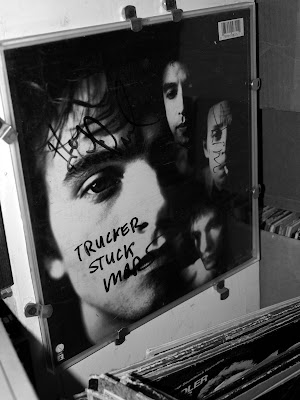
As she was getting ready to ring up Sorry Ma… she said, “God, I love these guys.” Then: “Wait, you gotta see this,” and again she raced around from behind the counter. In a second she was standing in front of one of the building’s columns, moving a very dusty pile of vinyl. She moved pieces of the stack until she found what she was looking for: a pair of framed shots of the Replacements, one Warner press shot and one snapshot of the band signing autographs in the HOG, probably around 1985 or ’86. Both photos were autographed. I said to her, “Mind if I get a shot of these?” I turned my camera on and fired away.
Back at the counter I paid for the disc, refused the plastic bag, and was on my way when she jerked a thumb over her shoulder and said, “That’s them too.”
And there, chicken-scratched on the wall in black marker, among the band's signatures:
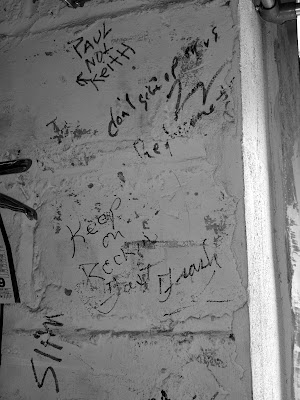
My head rang. There it was, the meat of those records, and their continuing – rising – appeal to me. Distilled to their essence. Because that’s it: that’s the pulsing, bloody, ragged heart of these songs, and of their effect on me: Don’t give up on us. Meaning: take our stance of disinterest with a grain of salt, but see beneath it; see that what we need is to hope for something bigger. We encrust it all in these layers of bullshit losers’ sloganeering in case, as we half suspect, there’s no point in hoping for something to deliver us. We’re steeling ourselves for the fall we’re almost certain awaits us if we strive. But without the slim hope, the minute sliver of a chance that somebody else is also holding out hope that we might be worth something – anything – we might as well be fucking dead. If you give up on me, I give up on me, and it’s over; I can just sit and wait to die.
I had come all the way to Rochester, to goddamned Irondequoit, to see this, to receive this bit of hope, like a grain of rice. I put it in my pocket and I headed home, back to my wife, my daughter, to my 30s.
I PLACE too much stock in music, depend too much on epiphanies gleaned from Westerberg and Coltrane and Joe Pernice and David S. Ware. I know that. If we’re all running around in 2009 creating self-contained worlds for ourselves and inventing the religious systems therein, then I’m taking musical performances as my scriptures. It might not be healthy, I suppose, but I’ve come too far, done it for too long to stop now. Something about the act of listening (the art of listening?) opens me up and renders me fertile for the seed of goodness. This sounds trite, but it’s true. It’s true that there are times when I simply don’t feel pure enough, good enough, in some way worthy enough to listen to John Coltrane. In those times I have to redeem myself with mind-blanking hard work, or a sincere act, before I feel right enough to listen to “Spiritual” or “Afro Blue” or, most religiously of all, A Love Supreme. There are also three or four pieces of music which have the power to centre and calm me, physically and mentally. Those are the things I plug into as I lay in bed at night, and the things I hum to myself when I feel anxious. With the Replacements, I knew they were right for my mindset, but before I saw that graffiti on the wall of the House of Guitars, I don’t think I could sum up just why, or what it was they said to me. Now I know: Don’t give up on us.
There is music for every emotion, for every longing and for every need, from ecstasy to lust to blackest depression to bemused indifference, etc. At different times I have need for all of it. The music of the Replacements is dear to me, is something I need more often than many others, because it says something I so badly need to hear, because it takes me someplace I desperately need to go: a place of hope amid the bullshit. For a couple of years now I have placed all my hope in my daughter – that’s what parents do, what they should do – but lately I have realized that I must reserve a small bit for myself, too. And that’s what the Replacements have helped me rediscover: the hope that we might be measured not as the people we are, but as the people we want to be.
Wednesday, September 17, 2008
If These Walls Could Talk
While in New York last weekend to see the stadia (Shea and Yankee) before they meet the wrecking ball (or the memorabilia-seekers), my father and I put in at the legendary Village Vanguard to see the trio of Paul Motian, Joe Lovano and Bill Frisell. Needless to say, a fantastic set, with Lovano taking the helm on most pieces, and Frisell getting frisky with his gadgets and toys, but never overdoing it, and with Motian pushing things along without getting in the way. But as much as the band, we were there to see the venue, the venerable Vanguard. Consider the list of names who've played there (for reference, go to All Music, do an album search on "Village Vanguard" and see what comes up; then figure how many have taken the stage without the tapes rolling). It was quite a night. And yes, Lorraine Gordon still takes drink orders.
So, because lists are the new analysis, here are my three favourite Vanguard-born recordings of all-time:
Sonny and his piano-free trio (Donald Bailey and Wilbur Ware on bass, Pete LaRoca and Elvin Jones on drums) took to the Vanguard stage in November of 1957 and cut enough material to fill two CDs (now available as The Complete..., whereas it used to be spliced into two volumes). The music is Rollins at his absolute best: agile, powerful, but with enough panache and humour that you might let your guard down and almost fail to recognize just how incredibly good, how dexterous a horn player he is. Few technicians sound this fun.
Also fun is running through these CDs a few times and then throwing Amon Tobin's brilliant Bricolage from 1997 into the CD player and spotting the samples culled from the former and sprinkled throughout the latter.
In June of '61, lyrical piano genius Bill Evans led a new trio down the tight stairway and into the club on 7th Avenue. The aforementioned Paul Motian occupied the drummer's stool (possibly the first time he'd been at the club, but not the last), and the bassist was the innovative Scott LaFaro. The rolling tapes captured enough music for two LPs that night, and they're both undisputed classics. Not bad for a day's work. Something about the sound of both Sunday... and Waltz for Debby is undeniably wonderful -- they sound like live jazz recordings should sound. I mean that both technically (the sound is clear, warm, perfect) and artistically. The interplay between these three men is astounding.
Now listen to "My Man's Gone Now" from Sunday at the Village Vanguard. Listen to the elegaic tone and try not to be affected by the knowledge that LaFaro would be gone ten days later, a victim of a car accident, not quite 26 years old.
If this comes as a surprise, you haven't been paying attention.
This is the point where John Coltrane jumped off into the abyss of complete artistic freedom. This is where he began exploring Eastern motifs and themes. This is where Eric Dolphy's sometimes-membership in the band bore it's greatest fruit. Coltrane used these handful of dates in November of 1961 to throw all his ideas into the hopper and see what emerged. He experimented with the makeup of his band, with new compositions, and with new techniques. He did all this with the critics and the curious fans in attendance. What he learned from these experiments set the trajectory for his art until his death.
This is essential listening. The thought that I was sitting in the same room that had borne witness to the creation of this music was as humbling an experience as I've ever known. If Coltrane is a religion, this is the first book of his New Testament.
Thursday, July 24, 2008
The Sound of Sound
Sound that stops the capacity for judgment. Sound that never decays. Sound that breaks free from every possible image. Sound that comes from both death and birth. Sound that dies. The sound around me. Sound like the symptoms of eternal cold turkey. Sound that resists private ownership. Sound that goes insane. Sound that spills over from the cosmos. The sound of sound.
- Kaoru Abe
If last Thursday’s edition of Now’s the Time had a goal, it was the approximate evocation of those words from the late saxophonist Abe. That, and keeping the needles pinned in the red. Happily, I think I did a decent job on both fronts.
Mark-O has an interesting story about Ascension, the 1965 Coltrane blow-out that I pinpointed as the baseline for the noise I played on the show. It goes something like this: One night he listened to Ascension really loud. Soon he fell asleep. The end.
See, the density of sound was so great that he began to hear it as a whole, not as disparate parts, and then it sounded to him like white noise, like a fan whirring in the dark, like ocean waves.
The point is this: reconsider what you think you know about noise. It’s uses and variations are myriad. Don’t try to impose conventional structure onto it, but instead celebrate it for what it is: the sound of sound.
I don’t expect to win over many with this line of argument; certainly for most, noise remains just that – an irritant, an aural eyesore, until organized into pleasing structures like melody and rhythm. I don’t mean to suggest that Abe’s improvisations, or Machine Gun, or Bells will make for nice dinner music. But if, having steeled your nerves, you want to engage this art on its own level (after all, real practitioners of noise aren’t about to meet you halfway), then I think you must view it in those terms. It is not tuneful. It is not easy. But it is vital. It expresses certain peculiarities of humanity that can’t otherwise be expressed with a musical instrument. It shrieks and careens and drops and exalts. Just as we do.
Anyway, that’s what I was trying to get across on the July 17 edition of NTT, an admittedly vague point illustrated by pieces from Coltrane, Abe, Albert Ayler, Peter Brotzmann, Frank Wright, the incomparable Last Exit, Ivo Pereman and Assif Tsahar. Feel free to download, listen and decide for yourself whether or not I was successful in doing so:
Now’s the Time – July 17, 2008: Free Radicals (or: The Sons of Ascension)
[PS - Hat tip to the amazing Destination: Out for that Abe quote.]
Monday, April 7, 2008
Interplay
The latest episode of Now's the Time went down last Thursday evening, and I must say, modestly speaking, I nailed it. There are nights in the studio when you have to concede that you're weren't quite on. But there are others when everything is falling into place, and there are no technical glitches to derail you, and you spend the long drive home, smiling, thinking: Hell yes, that was good.
Thereafter, I got my hard bop on. John Coltrane, until recently strung out, fired by Miles Davis, and searching for direction (some of which he found while woodshedding with Monk), spent much of the period between 1956-1958 collecting paychecks from Prestige Records. He was a member of a number of different session lineups, many of them billed as the Prestige All-Stars, as well as stints as a sideman, and occasionally he was co-billed (John Coltrane and Kenny Burrell). All of this is documented on the excellent Interplay, the Concord Music Group's recent repackaging of all of this previously available material. It sounds wonderful; warm and full. The package is handsome, and the liners are incredibly detailed. Great stuff.
Have I piqued your interest? Just download the show already:
Now's the Time - April 3, 2008: Impressions in Jazz Orch. / Coltrane's Interplay
I'm in the studio next on May 8, when I'll play music by Bengt Berger and his Bitter Funeral Beer band - worldy, free improv stuff by a large-ish ensemble, sometimes including Don Cherry.
I'll check in here next week with some non-improvised music related stuff.
Monday, March 31, 2008
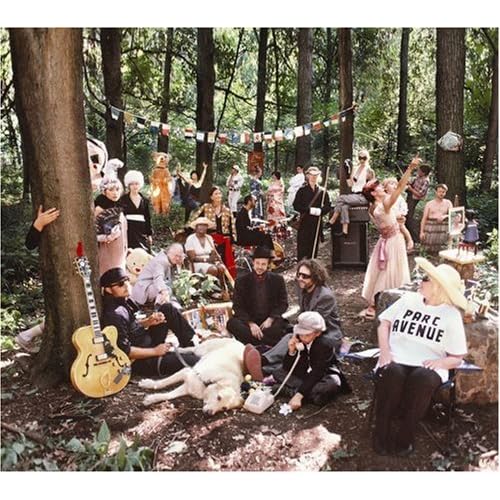
In Rotation: Parc Avenue
Why this? Why today? Because I couldn't find anything more appropriate for Opening Day, short of Terry Cashman. And I just couldn't do that (again).
I might be the last to hop this bandwagon, but the earthy, barefoot feel of this prog-folk-indie-Americana beast has me thinking of dirt between my toes. Spring - wouldn't that be nice?
There's also a pleasing Northern Lights-Southern Cross vibe simmering from beneath the surface (minus the, er, desperation?) that meets with my approval. Why is it Canadians do this stuff so much better?
In other news: The first issue of Eartrip magazine is available for DL. It features a Coltrane CD review I first posted here.
Also, another episode of Now's the Time is now up for you listening pleasure:
Now's the Time: Mark O's Year of the Guitar, Part 3: Kenny Burrell
And lastly, I'll be interviewing Adrian Cho, director of the Impressions in Jazz Orchestra, this Thursday on NTT. I'll then spend the last hour of the show spinning cuts from the Coltrane-as-sideman boxset Interplay. If you even sorta like hard bop, tune in. Essential listening.
Wednesday, February 6, 2008
The Moment, Suspended
Though I obsess over them, covet them, collect them and desire them, I recognize recordings of creative music for what they are: moments captured; snapshots of instants in musical time. In the context of free music, they are essentially by-products of the act of creation, at best; in some cases little more than marketing tools, promotional items designed to sustain the music-making lifestyle.
The great schism of American music pre- and post-bebop (or pre- and post-war) has everything to do with the primacy of the individual musician as creator, his/her position lofted above both composer and ensemble. The solo – the act of instantaneous and unique creation – is not a device peculiar to jazz or to
As artists supplanted entertainers – virtuosity trumping palatability, musicians adopting a cool stance, dark glasses, even literally turning their backs on their audiences – dancers became listeners. Music, you see, even lowly jazz, is art. This was the message. Listen careful and you might learn something. Seems natural now, but it was truly novel then.
Is art an act, or a product? Ask anybody from Charlie Parker on, and they’d tell you. Cut the albums, wait for the record company to put them out. By the time anybody hears them, you’re miles gone. New changes, new techniques, new style. Only thing the album’s good for is to get your name out, so that the next time you hit Chicago, LA, New York, Vancouver, Memphis, Seattle, Montreal or Tuscaloosa, the club’s full. The take from that night – a night of creation, of unique and fierce runs, of new depths of expression, of finding new corners within that tune you’ve played a thousand times – keeps you playing, keeps your art alive. I’m willing to bet the model held true for everyone from Dizzy to Lee Morgan to Miles Davis to Albert Ayler to Noah Howard…
And I’d guess it still holds true. Why else are so many forward-thinking artists embracing the online model? Let someone download a file, and maybe they’ll come see you next time you’re booked into their local cultural centre. Ask Dave Douglas. Ask Dennis Gonzalez. I did ask Michael White, and that’s exactly what he told me.
So what is the value of the recording? Why do so many of us devote so much time (and money) to them? What is the source of the undying appeal of the album?
My guess? It is precisely for the above-cited reasons. Recordings of improvised music provide a document of an artist’s development and approach at a specific point in time; they are lightning captured, time frozen, or as the title suggests, the Moment, suspended. This is why the chronology of recordings is so important. Consider John Coltrane’s 1965 output. There is no mistaking The John Coltrane Quartet Plays… (recorded in February) with Ascension (late June) or Kulu Se Mama (October). This accounts, too, for the importance in jazz studies, perhaps more than in any other musical discipline, of the hyper-detailed sessionography.
Or consider the Benedetti recordings. These documents provide a unique opportunity to study the rapid development of an artist over a condensed period, and I’d venture their peculiar genesis and the mystery that surrounded them until their CD release represent a set of circumstances that could only arise from the world of jazz/improvised music. Bird’s solos were mini-compositions, worlds of sound unto themselves. Like a photograph, Benedetti’s tapes refuse to betray their precise context. Like Cartier-Bresson’s famous image, we don’t have backstory, we can’t see what lies outside the frame, but we are nevertheless arrested by their fleeting arrangement, the very perfection of their brevity, their self-contained nature.
The moment comes, and then it goes. If you’re lucky, you’re there. You’re in the club or hall, and you’re close enough to recognize the flash of invention, the moment when a musician takes off and recombines a series of familiar ingredients into something incredible and new. The Moment. “Koko,” or “Chasin’ the Trane.” A moment when even the creators astonish themselves with the nature of the creation. But if you’re not lucky enough to be there, maybe a recording engineer is. And then there is evidence of that moment, a tangible artifact. A thing to hold and help with the archaeological recreation of an artist’s path, a document of a different take on an old tune, or an impassioned invention from scratch, or a 27 chorus, legend-birthing solo. The artists live these moments, and then move on, and many times can’t understand what the fuss is about. But we fans, we collectors, are equal parts music-lovers and historians, parsing the evidence, reliving the moments. Longing to re-experience that high-wire act of spontaneous creation over and over and over again.
Tuesday, January 15, 2008
Housecleaning: Best Songs of 2007 / Baseball / Michael White
Alright, time to face facts: I've lost that loving feeling as far as writing about 2007 is concerned. It just feels so, I don't know... over. So rather than hem and haw and force myself to spew out a thousand dispassionate and listless words on the topic of the best songs from that long-ago time, as I had promised to do, I will instead just give you the list, and let you fill in snarky/clever/thoughtful and poignant little write-ups about each one.
So, the songs, in the order they appear on the TiOM: Bo2007 CD (i.e. not ranked) are:
01 His Name is Alive, “Sweet Earth Flying”
02
03 Iron & Wine, “Wolves (Song of the Shepherd’s Dog)”
04 Yeasayer, “2080”
05 Burial, “Shell of Light”
06 M.I.A., “Paper Planes”
07 Chromatics, “In the City”
08 Battles, “Atlas”
09 Kanye West, “Stronger”
10 Caribou, “Melody Day”
11 Spoon, “You Got Yr Cherry Bomb”
12 Stars, “Take Me to the Riot”
13 Robbers on High Street, “The Fatalist”
14 Feist, “I Feel it All”
15 Band of Horses, “Is There a Ghost?”
16 The
17 Okkervil River, “Our Life is Not a Movie or Maybe”
18 The National, “Apartment Story”
That was weird. I don't even remember 2007.
Baseball
Nextly, it's no secret to anyone who occasionally reads this blog that I love (lurve!) baseball, but I suspect that many of those who do frequent TiOM are not exactly what you'd call "baseball fans." So rather than subject them to the arcane and pithy details of the game and my rants thereon, when all they're really looking for is my incredibly narrow view of the world of music, I've created a new spot for all things beisbol related. Trip on over to The Bottom of the Order (bottomoftheorder.blogspot.com) if you're interested. If not, stay put.
Michael White
Okay, I'm very excited about this: I have just this very evening conducted an interview with the great jazz violinist Michael White. I've mentioned him here before, but you can expect something more detailed to appear in the days (weeks?) to come. Very gracious man, and a wonderful conversation. It blew my mind just a little bit that this man, who has played with Dolphy, Coltrane, Joe Henderson, John Handy, and scores of others, was answering the questions I was asking as I sat at my kitchen table (thank you, Skype!) The interview will air on January 24 on Now's the Time. More details as that date approaches.
Sunday, December 16, 2007
The Twelve Days of Listmas: Day One
25 Kevin Ryan, Dylan Hears a Who
Whoever he is, Kevin Ryan held the world – or at least the world of online music blogs – in his hand for a short time earlier this year. He painstakingly constructed a brilliant parody (homage? mash-up? commentary?) and floated it out onto the web, then stayed silent as the attention mounted. The perfectly constructed back story had a circa ’66 Bob Dylan paying tribute to the works of Dr. Seuss by recording seven Seuss stories as songs the way only Bob could play ‘em. Then, the story went, the album was scuttled by nervous label suits, and was thereby lost. Ryan’s Dylan impersonation is solid, but the real selling job comes from the music, which is nigh on indistinguishable from the real thing, with authentic sounding tape hiss and crackle, perfect instrumentation, and a mixing job that sounds like a studio floor recording from the period. Add to that wonderful (downloadable) cover art that looks eerily like something
24 John Coltrane, My Favorite Things: Live at
I already wrote about this here, so why repeat myself, right? I remember thinking that title – What a Difference Roy Haynes Makes – was pretty darned clever at the time.
The This is Our Music End-of-Year Form Letter
Dear Reader,
Like the proverbial peas and mashed potatoes, I have tried in vain to keep them separate.
I have, in years past, done my best to segregate two aspects of my music consuming personality, treating rock/pop and jazz/improvised/whatever as wholly separate entities, affording each their own list, and generally endeavouring to keep each ignorant of the other’s existence. But as anyone who has ever attempted to corral the peas and keep them free of starchy goop knows, you can’t do it; you can’t keep them apart.
So this year’s This is Our Music master list – the albums list – marks my defeat, standing as the first time that I have relented and combined both sides in one unified whole. And the catalyst was Warren Defever.
Defever, headman of His Name is Alive, has made some interesting music over the years, incorporating a wide variety of sounds, and generally displaying a pleasingly restless approach to the conventions of musical genre. But it was still all stuff I would feel comfortable filing in the Rock/Pop section (or possibly the Alternative section, if the imaginary record store in question still had such a relic). But then HNIA went and did this, leaving me with the difficult decision of which list to put it on. And that got me to thinking…
Why not a unified list? Why not the 25 recordings I enjoyed most, regardless of genre, in one complete accounting of my year as a consumer of music? Solidarity!
So that’s what I’ve done, and beginning with the next TiOM post, I’ll dive into that list – a list of pop and indie rock and disco and electronic trickery alongside a Coltrane reissue (shock!), a couple of sets of modern jazz that won’t offend the non-jazz listener, and some downright woolly free improvisation. It’s a list that accurately represents – maybe for the first time – the entire range of my interests.
Merry Listmas.
Sincerely,
/a
PS - You feel a little guilty for laughing at that picture, don't you? You should. For more guilt-inducing hilarity, click here!
Saturday, August 25, 2007
My Favorite Things (or: What a Difference Roy Haynes Makes)
I don’t know just how many versions of Rodgers and Hammerstein’s “My Favorite Things” John Coltrane recorded, but conservatively speaking it numbers in the dozens, the majority of them performed by the “classic quartet” of Coltrane on saxophone (soprano), McCoy Tyner on piano, Jimmy Garrison on bass and Elvin Jones on drums, but several versions do feature different lineups, too. The song held a deep fascination for Coltrane; it was a measuring stick for his mastery of the soprano, for his bands’ cohesiveness and communication; and for listeners, it provides insight into the development of the sound John William Coltrane heard in his head. It varies from the buoyant near-pop hit originally recorded and released on the album of the same name (Atlantic, 1960) to the brutal and coarse assault of 1967’s The Olatunji Concert, recorded shortly before his death. In between, there are shorter versions, and marathon versions with lengthy bass solos. I probably have a dozen or more iterations in my collection, and it seems every time I buy another Coltrane release (which I do with alarming regularity), my wife jokingly asks, “Does he do ‘My Favorite Things?’” It’s an apt question, for what can be the appeal of hearing the same song over and over and over again by the same musician? The answer is that it is always and never the same.
The dervish-like sound of that soprano horn is a constant, as is the obvious commitment, skill and passion of the musicians involved. But in almost every other respect, they are unique. The sound, the feel - there is always some detail which differs in the telling. The 1960 Atlantic is joyful and breathless; the nearly hour-long Japanese performance is grueling but rewarding; the above-mentioned Olatunji version is harrowing and raw; the Half Note recording sounds more exotic than most others. Interestingly, there are two versions on the latest live Coltrane CD release (and I sincerely hope they keep uncovering/repackaging/recombining this stuff), fittingly titled My Favorite Things: Coltrane Live at Newport. The CD is a compilation of Trane’s performances at that revered Rhode Island festival in 1963 and ’65 with his quartet. What’s noteworthy is that the two performances feature slightly different lineups – the classic group in ’65, but with veteran drummer Roy Haynes filling in for the, um, “ill” Elvin Jones in 1963.
What the 1963 version makes plain is the exact nature and overall importance of Jones’ contribution to the quartet’s sound. There is no question that Coltrane’s horn is the lynchpin of the whole, this music machine which, even at it’s most unrestrained and out, retains an elegiac sound - the sonic embodiment of the leader’s spiritual quest. But Jones’ high-hat, his momentum, the series of mini-crescendos he produces, are a sizeable contributor to that brimstone-scented religiosity. Without them, the band is a different entity altogether.
The 1963 version with Haynes on drums is lighter, skippier, than most others. It has a snap generally not present with this group (and that is most certainly not a criticism, simply an observation), a hard-bop oomph as opposed to a church music bombast. Haynes leads the group down different paths, producing a sound which suggests this band might’ve had a career as a supremely professional club act, had they chosen to pursue that end.
Jones is irreplaceable. Without him, the Classic Quartet would’ve been a different band. Haynes is himself a consummately skilled drummer, a true great, but what would A Love Supreme have sounded like with him and not Jones in the chair? The 1963 Newport performance is stunning and wondrous, and singular in the panoply of Coltrane’s performances of the song. But its greater importance is in removing one of the legendary group’s key elements and, in doing so, confirming that element’s significance to the band’s astonishing body of work.
I will forever be transfixed by John Coltrane’s renderings of “My Favorite Things,” a warhorse of a standard that would prove the artist’s longstanding obsession. It was his Leaves of Grass, the thing to which he returned again and again, tweaking, further exploring, revising, plumbing, editing. This latest available version has added a new dimension to my appreciation of the song, and of the band which performed it so many times.